
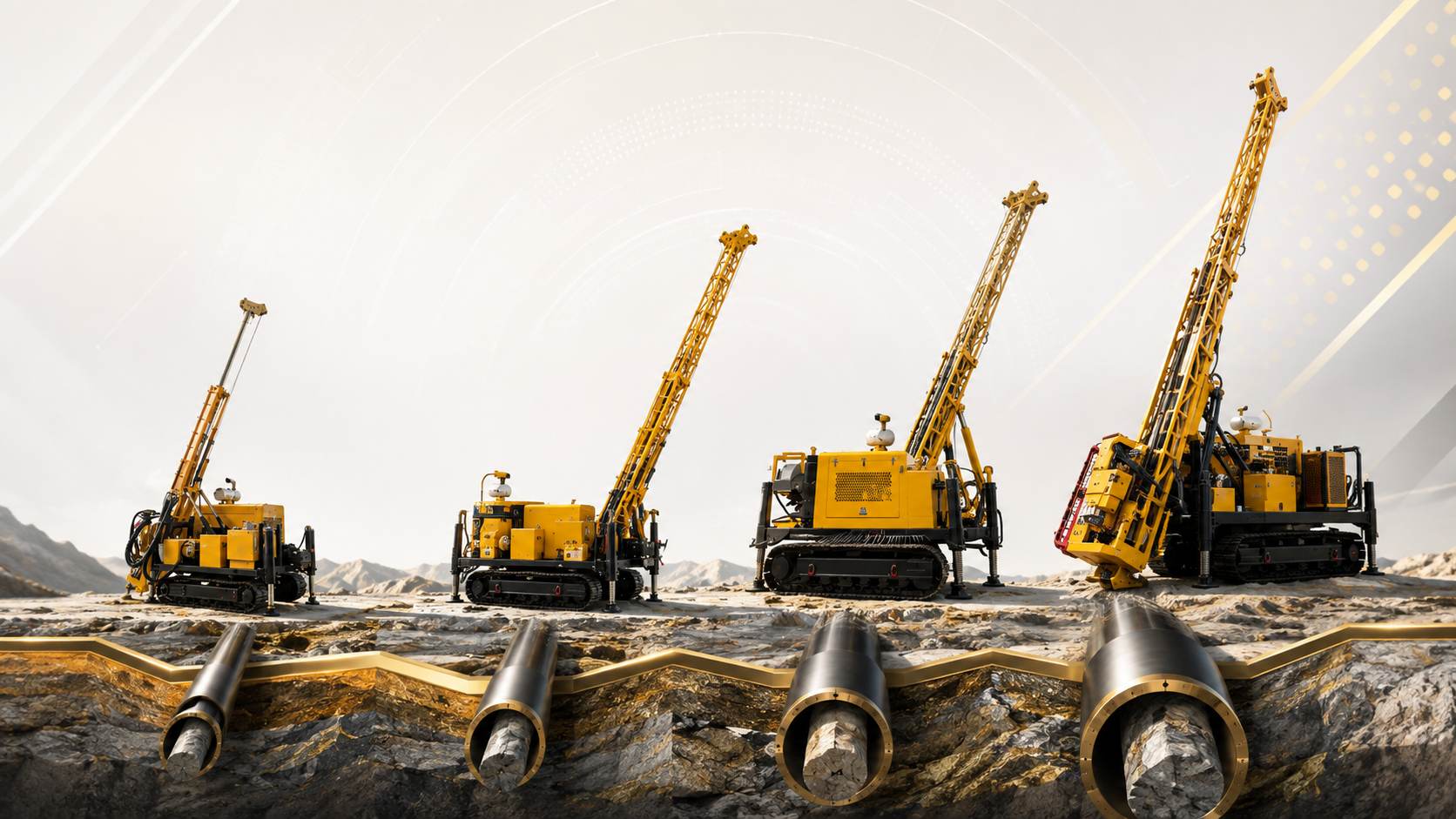
A surface core drilling rig should be selected around the largest rod size and deepest hole it must handle—not the diameter used on an easy first project. Moving from BQ through NQ and HQ to PQ increases core volume, rod weight, torque demand, fluid requirement, and handling load. A rig that performs comfortably with NQ tooling may slow considerably when asked to pull long HQ strings. Buyers therefore need to compare drilling depth, formation, hole angle, pullback, rotation system, mast capacity, mud pump, wireline equipment, and site access as one package.
How Does Rod Size Change the Work a Core Drilling Rig Must Perform?
BQ, NQ, HQ, and PQ are not merely interchangeable rod labels. Each step upward changes the mechanical and hydraulic load placed on the drilling system.
Why Does a Larger Rod Size Need More Torque and Pullback?
Larger rods, core barrels, and bits create more contact area and greater rotating mass. As depth increases, friction along the string also rises. Broken ground, swelling formations, poor flushing, and hole deviation can add resistance well beyond the weight of the rods themselves.
Pullback capacity becomes especially important during recovery from a tight hole. The rig must lift the full string, overcome drag, and still maintain a working safety margin. A published pullback figure should not be treated as the recommended continuous load.
Torque follows the same logic. Adequate torque is needed to maintain rotation in the intended formation, but extremely high torque is not always desirable. Excessive torque applied through unsuitable rods or a stuck barrel can damage threads and complicate recovery.
What Does the Larger Core Sample Add to the Project?
BQ produces a smaller core and lighter tooling, which can reduce transport and handling requirements. NQ is widely used where buyers need a practical balance between sample size, depth capability, and operating cost. HQ provides a larger core that can help preserve fractured material and give geologists more material for logging or testing. PQ increases sample volume further but places substantially greater demands on the rig and support equipment.
The larger sample may be valuable, yet it costs more to obtain. Fuel use, bit cost, water demand, rod-handling time, and transport weight should be considered before specifying HQ or PQ across an entire program.
Which Rig Specifications Matter Most for BQ, NQ, HQ, and PQ Drilling?
Manufacturers often publish maximum drilling depths by rod size. Those figures are useful for comparison, but they normally depend on favorable assumptions about hole condition, angle, formation, tooling, and operator practice.
How Should Buyers Read Depth Ratings?
A rig rated for a certain depth in NQ may have a much lower practical limit in HQ or PQ. The heavier string consumes more hoisting capacity, while the larger bit demands more torque and circulation. Deviated or unstable holes further reduce the margin.
Buyers should ask how the depth rating was established. Was the hole vertical? What rod weight and core barrel were assumed? Was the value based on pullback, hoist capacity, torque, or a calculated limit? A technically useful supplier can explain the assumptions rather than presenting one number without context.
For projects near the published maximum, select additional capacity. Running continuously at the limit leaves little room for stuck rods, added casing, water in the string, or formation-related drag.
Which Mechanical Systems Need Close Review?
The rotation unit must accommodate the selected rod diameter and deliver suitable speed and torque across the expected formation range. High rotational speed may suit competent rock and smaller bits; broken or abrasive formations may require a different balance.
The feed system controls bit pressure and penetration. Its stroke should match the preferred rod length and operating method. A short feed stroke increases chuck changes and slows rod handling. The mast, foot clamp, chuck, breakout system, and rod handler must all accept the intended tooling.
Do not overlook the main hoist and wireline hoist. Surface core drilling depends on efficient inner-tube retrieval. Hoist speed, line capacity, braking, and guarding directly affect shift productivity and operator workload.
When Should a Project Use BQ, NQ, HQ, or PQ Tooling?
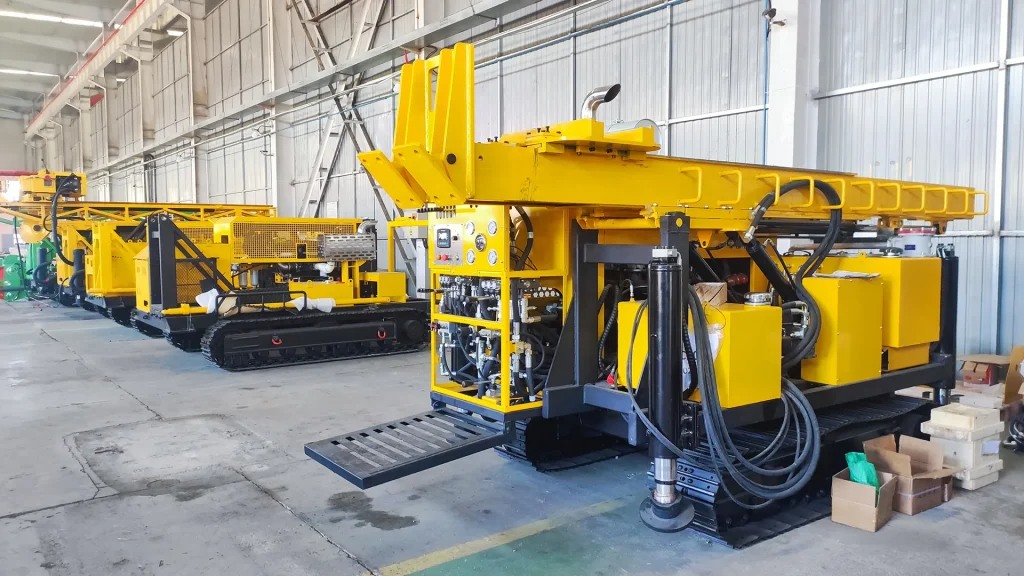
Rod selection should begin with the geological objective. Rig selection follows afterward. Starting with the largest machine available can add unnecessary transport and operating cost; starting with a small rig can restrict the sampling program later.
Where Do BQ and NQ Make Practical Sense?
BQ can be suitable for relatively shallow work, constrained sites, portable drilling, and projects where a smaller core provides sufficient geological information. Its lighter tooling is easier to handle manually, although the smaller core may be less useful in highly fractured formations.
NQ is often selected as a middle ground. It provides more sample than BQ without imposing the same rig, pump, and rod-handling requirements as HQ or PQ. For many mineral exploration programs, NQ supports reasonable penetration rates while keeping consumable and logistics costs manageable.
Neither size should be chosen solely because the rig can turn it. Core recovery, required laboratory sample mass, structure orientation, and formation competence remain central.
When Do HQ and PQ Justify Their Higher Operating Load?
HQ is worth considering where larger, more intact core improves geological interpretation, geotechnical logging, structural measurement, or sample preparation. It may also be selected near the upper part of a hole before reducing to NQ at depth.
PQ can be appropriate for large-diameter geotechnical sampling, difficult ground, or programs requiring substantial core volume. The trade-off appears everywhere else: heavier rods, larger casing, higher fluid demand, slower manual handling, and more demanding site access.
Telescoping from a larger diameter to a smaller one can extend a hole after upper sections become unstable. The rig and tooling plan should account for that possibility before mobilization.
How Do Site Conditions Affect Surface Core Drilling Rig Selection?
A technically capable rig may still be wrong for the site. Access, bench size, slope, water availability, weather, and transport restrictions can determine whether the machine operates efficiently.
What Changes at Remote or Restricted Locations?
A compact rig is easier to move through narrow roads, steep ground, or environmentally sensitive areas. However, reducing rig size may also reduce pullback, mast capacity, rod-handling assistance, and onboard storage.
Support equipment needs space too. Rod racks, casing, core trays, mixing tanks, pumps, fuel, and service vehicles can occupy more ground than the rig itself. A layout that looks workable on a drawing may become crowded once full rod strings and safe lifting zones are included.
For helicopter-supported or track-mounted work, component weight and dismantling time deserve close attention. The lightest rig is not necessarily the quickest system if frequent setup and manual handling slow every shift.
How Do Water Supply and Ground Conditions Affect the Equipment Package?
Larger holes require greater circulation capacity. The mud pump must provide enough flow and pressure to cool the bit, transport cuttings, and maintain the hole without washing away fragile core. Pump selection should reflect rod size, depth, fluid system, and expected losses.
Broken ground may require casing advancement, additives, or staged diameter reduction. Abrasive formations influence bit wear and rotational settings. Cold conditions affect hoses, pumps, lubricants, and water management.
The rig should also provide controlled low-speed rotation and feed response for difficult intervals. A machine optimized only for fast drilling in competent rock may be frustrating when the formation changes.
What Should Buyers Verify Before Purchasing a Core Drilling Rig?

A rig purchase should be evaluated as an operating system rather than a power unit with a mast. Compatibility gaps often appear after delivery, when the buyer discovers that clamps, chucks, hoists, pumps, or rod tools do not suit the planned program.
Which Details Should Be Confirmed During Technical Review?
Provide the target depth for each rod size, hole inclination, expected formation, rod length, casing plan, core barrel type, wireline system, water conditions, and site-access limits. Then review pullback, torque curves, rotation speed, feed force, mast stroke, chuck range, clamp capacity, and hoist specifications.
Ask whether published capacities include the rod handler, mast position, and auxiliary equipment shown in the quotation. Engine output alone does not describe drilling performance. Hydraulic efficiency, cooling capacity, and duty cycle affect how the rig works through a full shift.
Maintenance access also matters. Filters, hoses, wear pads, clamps, and service points should be reachable without dismantling major assemblies.
What Should Be Checked Before Final Acceptance?
Inspect the rig with the intended rod sizes where possible. Confirm chuck and foot-clamp engagement, rod clearance, mast alignment, feed travel, breakout function, emergency stops, guards, and control response.
Review the supplied tooling list carefully. Rod wrenches, lifting plugs, recovery tools, adapters, wireline components, spare seals, filters, and service kits are easy to miss in the original quotation.
Documentation should cover operation, maintenance, hydraulic systems, electrical systems, spare parts, and troubleshooting. Buyers should also establish commissioning responsibilities, operator training, warranty scope, and parts support before shipment.
How Can a Drilling Equipment Supplier Support Rig Selection?
TDS (The Drill Store) supplies geotechnical drilling equipment, tooling, and related components for surface drilling programs. Buyers can provide target depths by BQ, NQ, HQ, and PQ rod size, expected geology, hole angle, rod length, casing requirements, site access, and water conditions. Technical review can then compare pullback, torque, rotation speed, feed travel, mast capacity, chuck range, hoists, pumps, and rod-handling equipment. Before purchase, the equipment list should identify tooling compatibility, included accessories, spare parts, manuals, commissioning requirements, and service responsibilities. This gives drilling contractors and project teams a clearer basis for comparing complete operating packages rather than relying on one headline depth rating.
Conclusion
Surface core drilling rig selection by BQ, NQ, HQ, and PQ rod size requires more than matching a catalog depth. Larger tooling increases sample volume but also raises torque, pullback, circulation, handling, and transport demands. Buyers should define the geological objective first, then check the rig’s full operating envelope under realistic hole conditions. Adequate reserve capacity, compatible tooling, practical site logistics, and accessible technical support reduce downtime when the program moves beyond straightforward drilling.
FAQs
1. Can One Surface Core Drilling Rig Handle BQ, NQ, HQ, and PQ Rods?
Some rigs can handle all four sizes with suitable chucks, clamps, tooling, and power. Buyers must still verify practical depth, torque, pullback, hoist, and pump capacity for each size.
2. Is NQ or HQ Better for Mineral Exploration Drilling?
NQ offers a useful balance of core size, depth, and operating cost. HQ provides larger core for fractured ground or detailed logging but requires heavier tooling and greater rig capacity.
3. Why Is Maximum Drilling Depth Lower With PQ Rods?
PQ rods and core barrels are heavier and larger. They demand more pullback, torque, circulation, and handling capacity, reducing the practical depth available from the same drilling rig.
4. Should Rig Capacity Exceed the Planned Drilling Depth?
Yes. Reserve capacity helps manage casing, water-filled rods, hole deviation, friction, unstable formations, and stuck tooling. Operating continuously at the published limit leaves little recovery margin.
5. What Should Buyers Include in a Core Drilling Rig Inquiry?
Include rod sizes, target depths, hole angles, geology, casing plan, rod length, core barrel, site access, water supply, transport limits, required tooling, training, and spare-parts expectations.
 French
  English
  Portuguese
  Spanish
  Russian
  Italian
  German
  Dutch
Dutch  Arabic