
Buying a rig for a 500–1000 m mineral exploration program sounds straightforward until the drilling plan is placed beside the equipment specification sheet. A machine may carry a 1,000 m or 1,300 m depth rating, yet that number alone says little about how comfortably it will work on a particular project. Rod diameter, hole angle, ground condition, flushing demand, retrieval load, and the number of deep holes all change the answer. For contractors and exploration teams, the better approach is to size a surface core drilling rig around the work it will perform most days, while leaving enough reserve for the holes that become difficult.
How Should Buyers Interpret a Rig’s Maximum Drilling Depth?
Maximum depth is useful for narrowing a shortlist, but it should not be treated as a universal working limit. Published depth ratings are tied to a particular drilling configuration, and the usable capacity changes when that configuration changes.
Before comparing machines, buyers should understand what sits behind the headline number.
Check Which Rod Size the Depth Rating Uses
A rig may be capable of substantially different depths with NQ, HQ, and PQ drill strings. In one documented hydraulic surface core rig, the stated capacity is 1,300 m with NQ/71 mm pipe, 800 m with HQ/89 mm pipe, and 500 m with PQ/114 mm pipe.
That difference matters during procurement. A contractor planning mainly NQ holes at 700 m is looking at a very different operating load from a contractor expecting HQ holes near the same depth.
The useful question is therefore not:
“How deep can this rig drill?”
It is:
“How deep is this rig rated to drill with the rod system we actually intend to use?”
Separate Occasional Depth From Routine Depth
A machine that occasionally finishes a hole near its rated limit may be perfectly suitable. A machine expected to spend most of the season near that limit deserves more scrutiny.
Deep holes bring longer rod trips, heavier strings, greater retrieval loads, and more time spent dealing with borehole friction. A little unused capacity at shallow depth can become valuable working margin later in the hole.
How Do Rod Size, Hole Angle, and Ground Conditions Affect Required Capacity?
Two holes with the same final depth can place very different demands on drilling equipment. Rod size is one reason, but it is not the only one.
Once the basic depth requirement is known, buyers should look at how the hole will actually be drilled.
Larger Rod Systems Change More Than Core Diameter
Moving from NQ to HQ or PQ means handling a larger drilling system. That affects rotation, lifting, flushing, clamping, and rod-handling work.
Larger systems also require the correct chuck and clamping arrangement. Multi-size compatibility should therefore be checked carefully during quotation review. A specification may say a rig accepts several rod sizes, but the buyer still needs to know which jaws, clamps, adaptors, and related components are included in the supplied configuration.
This is one of those details that looks minor in an office and becomes important very quickly on site.
Inclined Holes Can Feel “Deeper” to the Machine
Hole depth is measured vertically or along the borehole, but the rig experiences load differently when the drill string rubs against the borehole wall.
In an inclined or deviated hole, drag can increase as the string becomes longer. Broken formations, unstable sections, casing, or poor hole cleaning add another layer of resistance.
For that reason, a contractor planning a series of inclined holes should not assume that a nominal depth rating will translate directly into the same working margin available in a clean vertical hole.
Which Rig Specifications Deserve More Attention Than the Depth Number?
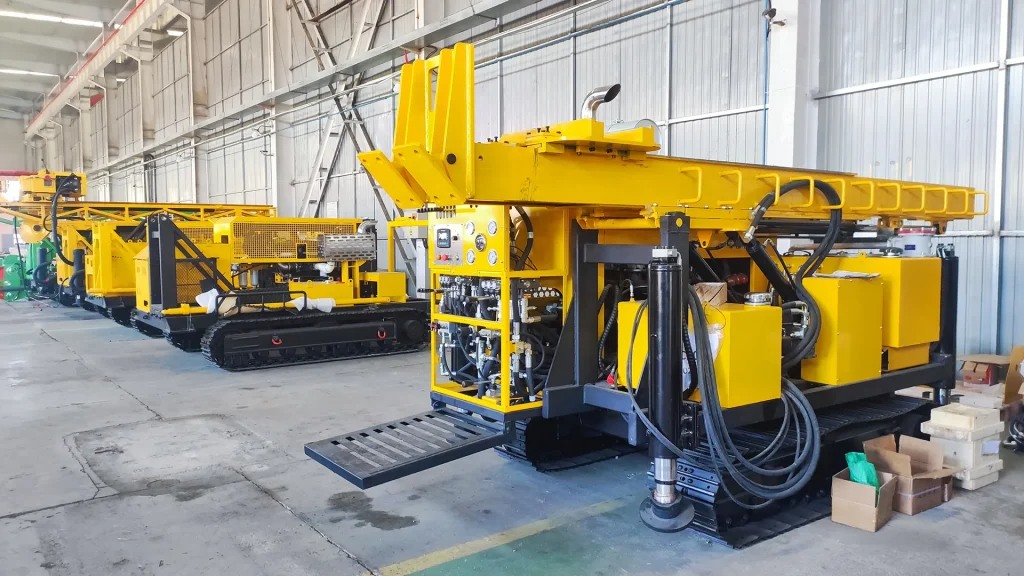
Once buyers stop looking at maximum depth in isolation, the comparison becomes more useful. Several specifications begin to matter together rather than separately.
The most important ones relate to how the machine rotates, feeds, retrieves, and cleans the hole.
Look at Torque, Speed, Feed, and Pullback as a Group
Torque tells only part of the story. A surface core drilling rig also needs an appropriate rotational speed range, controlled feed, and enough lifting force for the planned drill string.
For reference, a documented 1,300 m-class hydraulic rig uses a power head with maximum torque of 4,279 Nm, maximum rotational speed of 1,200 rpm, a 3,300 mm feed stroke, 100 kN lifting force, and 40 kN downforce.
Those figures are not purchasing targets for every project. Their value is that they show what buyers should compare: not one impressive number, but the relationship between several working functions.
Do Not Ignore the Mud Pump and Wireline System
Deep coring is also a circulation and retrieval job.
The mud pump has to move enough fluid for the selected drilling system and formation. Poor hole cleaning can show up as rising torque, slower penetration, excessive wear, or difficulty retrieving tools.
Wireline capacity deserves similar attention. Every deep hole involves repeated inner-tube retrieval, and the time spent doing that accumulates over a long program. Winch capacity, rope length, operating speed, and ease of access all affect daily productivity even though none of them appears in the maximum-depth headline.
Where Does the Wrong Rig Size Start Costing Money?
The cheapest machine to buy is not always the cheapest machine to drill with. At the same time, purchasing far more capacity than the project needs can also be difficult to justify.
The cost problem looks different depending on whether the rig is too small or too large.
An Undersized Rig Usually Reveals Itself Late
At shallow depth, a marginal machine may work normally. The problems tend to become more visible after hundreds of meters of rod are in the hole.
Retrieval takes longer. Pullback reserve becomes more important. Borehole drag is harder to overcome. A stuck string that would be manageable with additional lifting capacity can turn into a lengthy interruption.
This is particularly expensive because the crew has already invested considerable time in the hole.
Maintenance also becomes less forgiving when equipment routinely works close to its limit. Chuck condition, lubrication, hydraulic oil, cooling, filters, and gearbox checks cannot be treated as secondary tasks.
An Oversized Rig Creates Costs Earlier
Too much capacity has a different penalty.
A larger machine may require heavier transport, wider access, stronger site preparation, more fuel, or a larger mobilization package. Those costs arrive before the extra capacity has produced any benefit.
For a program dominated by 500–600 m NQ holes, buying a much larger machine simply because one hole might eventually go deeper may not make economic sense.
The better comparison is cost per workable meter across the entire program, not purchase price alone.
What Should Be Confirmed Before a Rig Is Added to the Purchase Order?
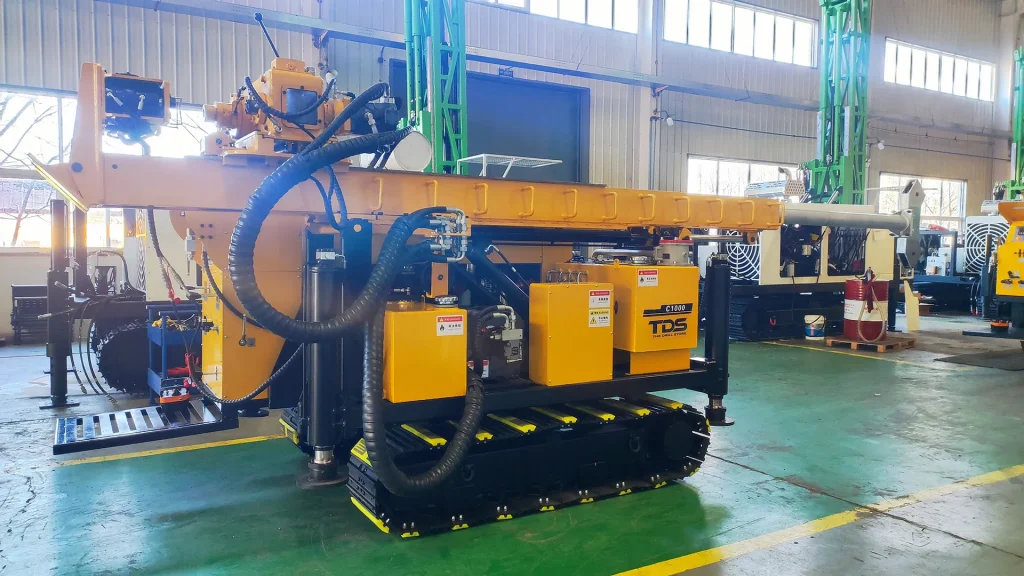
A good technical review should make the eventual drilling crew’s job easier. If major operating questions are still unanswered when the purchase order is issued, they will usually reappear later at the drill site.
A short list of practical checks can prevent many of those problems.
Match the Quotation to the Actual Drilling Plan
Buyers should provide the supplier with more than a target depth. Useful information includes:
- expected NQ, HQ, or PQ usage;
- normal and maximum hole depth;
- vertical or inclined drilling;
- expected rock and overburden conditions;
- casing requirements;
- site access;
- climate and altitude where relevant;
- planned drilling schedule.
With that information, rated depth becomes one part of a larger equipment decision.
Check What Is Actually Included
The quotation should clearly identify the power head, chuck arrangement, mast, main winch, wireline winch, mud pump, clamps, tooling interfaces, hoses, filters, and other required accessories.
Maintenance documentation deserves attention too. Typical pre-start requirements for a hydraulic core rig include checking engine oil, coolant, hydraulic oil, lubrication points, and control positions before the machine goes into service.
It is also worth confirming spare parts and consumables before shipment. A low-cost missing part is not low-cost if it stops a remote drilling program for several days.
How Can a Supplier Help Buyers Avoid Over- or Under-Specifying a Core Rig?
TDS (The Drill Store) supplies drilling rigs, compressors, drilling tools, casing systems, and related equipment for mineral exploration, mining, quarrying, water-well drilling, engineering construction, and infrastructure projects. For surface coring applications, useful equipment selection begins with the drilling program rather than a particular model number. Buyers can provide target depth, rod diameter, hole angle, geological conditions, access limitations, and expected workload so the rig configuration can be reviewed together with flushing equipment, rod-handling requirements, tooling, consumables, and spare parts. This approach is particularly useful for projects in the 500–1000 m range, where a modest change in rod size or normal working depth can materially change the capacity required from the drilling system.
Conclusion
Een surface core drilling rig for 500–1000 m exploration should be chosen around the real drilling program, not the largest depth figure in a brochure. Rod size, hole angle, routine depth, pullback, flushing, retrieval, site access, and maintenance all influence how much capacity is actually needed. Too little reserve can slow the difficult part of a hole; too much capacity can increase mobilization and ownership costs. The most practical choice is the rig that handles normal work comfortably and still has room for the conditions that rarely go exactly as planned.
FAQs
1. Is a 1,000 m depth rating enough for a project with 1,000 m holes?
Not necessarily. Buyers should first confirm which rod size the rating is based on and whether the holes are vertical or inclined. Routine drilling near the rated limit may justify additional capacity.
2. Why does the same surface core drilling rig have different NQ, HQ, and PQ depth ratings?
Larger drill strings increase weight and change the demands on rotation, lifting, flushing, and rod handling. As rod size increases, the practical rated drilling depth of the same machine can decrease.
3. Should a contractor buy a larger rig for occasional deep holes?
It depends on how often those holes occur and how difficult they are expected to be. Extra capacity may help with recovery and deeper drilling, but transport and ownership costs should also be considered.
4. What specifications should be compared after maximum drilling depth?
Torque, rotation range, feed stroke, lifting force, winch capacity, mud-pump capability, chuck compatibility, drilling angle, transport size, maintenance access, and the supplied accessories all deserve review before purchase.
5. How can buyers tell whether a core drilling rig is undersized?
Warning signs include limited lifting reserve at depth, slow rod retrieval, difficulty handling larger rod systems, frequent operation near hydraulic limits, and insufficient margin when borehole friction or difficult ground conditions increase.
 Dutch
Dutch  English
  Portuguese
  Spanish
  Russian
  Italian
  German
  French
  Arabic